

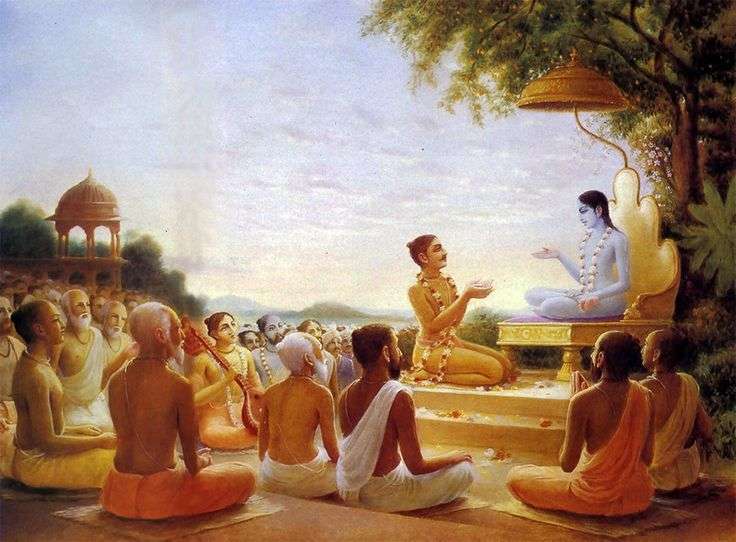
 One day, Vallabha Bhatta went to Lord Caitanya and asked him to listen to the commentary on Srimad-Bhagavatam that he had written. Proud of his work, he went so far as to claim that it was far superior to that compiled by Sridhara Swami. The Lord did not like this arrogance, so He refused to listen. He said that He did not feel qualified to listen to the Bhagavatam and simply chanted the name of Krishna day and night. To which Sri Vallabha said:
“I have tried to speak very elaborately about the Holy Name of Krsna. Please listen to my explanation.”
Mahaprabhu replied:
“I do not accept many different meanings of the Holy Name of Krsna. All I know is that Lord Krishna is Syamasundara and Yasodanandana. That’s it.”
It was then that Lord Gauranga recited that verse from Nama-kaumudi. He then added:
“I only know these two names, Syamasundara and Yasodanandana. I don’t understand any other meaning, nor do you have the ability to understand them.”
The story of Lord Caitanya’s punishment of Vallabha Bhatta is recorded in Caitanya Caritamrita, Antya-lila ch. 7.
Of course, the names of the Lord are infinite and all are transcendentally pleasing. It is obvious that Lord Caitanya only intended to induce Vallabha Bhatta to a more humble mindset.
Realizing that the pleasure of bhakti was superior to that which comes from the understanding of impersonal Brahman, Vyasadeva taught the Bhagavatam to Sri Sukadeva, who then immersed himself in impersonal meditations. As soon as Sukadeva Gosvami heard the Bhagavatam, he immediately realized the supremacy of Krishna’s personality and immediately changed his heart.
Then a problem of chronology is solved: which of the two scriptures, the Bhagavatam or the Maha-bharata, is the older?
Speaking on the subject, Prabhupada says:
“The Maha-bharata was compiled before the Bhagavatam and the Puranas before the Maha-bharata.” (Srimad-Bhagavatam 1.7.8, commentary):
Jiva Gosvami says that the Bhagavatam is both earlier and later. In fact, he claims that the Bhagavatam was written in abbreviated form before the Maha-bharata and then, based on Narada’s instructions, expanded to the form we know today.
In section forty-nine, Sri Jiva returns to the point of Saunaka Rsi’s question:
“How is it that Sukadeva, despite being already liberated, underwent a long study of Srimad-Bhagavatam?”
Again, because the pleasure of devotional service is far greater than that of impersonal realization, Vyasa knew that his son would not stay at home and therefore educated him (reciting the Bhagavatam to him) while he was still in his mother’s womb. When he came out, Sukadeva deepened his study and subsequently recited the Bhagavatam, becoming much loved by Krishna’s devotees, just as they are all very dear to him.
Below is an interesting episode from the life of Sukadeva Gosvami, learned from the Brahma-vaivarta Purana. Srila Prabhupada also hints at this event.
It is known that Sukadeva refused to be born for fear of Maya. While still in his mother’s womb, he realized that Krishna could subdue Maya as he wished. Then he asked his father to bring him to the Lord, so that He could grant him immunity from any danger. Vyasa took Krsna there, and He calmed the fetus. Having received such blessings and thus eternally freeing himself from Maya’s knots, Sukadeva Gosvami came out of his mother’s womb and retired into a meditative life. Realizing that the only means of keeping him close to him was the Bhagavata Purana itself, Vyasa succeeded in reciting to him certain portions, those in which the greatness of the Lord was particularly evident. In this way, Krishna Dvaipayana Vyasa, a descendant of Parasara, fascinated his son’s heart and was able to teach him all the work. This episode makes evident the greatness of Bhagavatam.
At the end of the section, Jiva Gosvami warns everyone to study Srimad-Bhagavatam according to the teachings of the original narrators, Vyasa and Sukadeva, and not otherwise. Any deviation would result in disaster.
This is a section of the book “Tattva Sandarbha”, in English.
To buy the complete book, click here

Leave a Reply