

 Eleventh Theme: The Spiritual Master
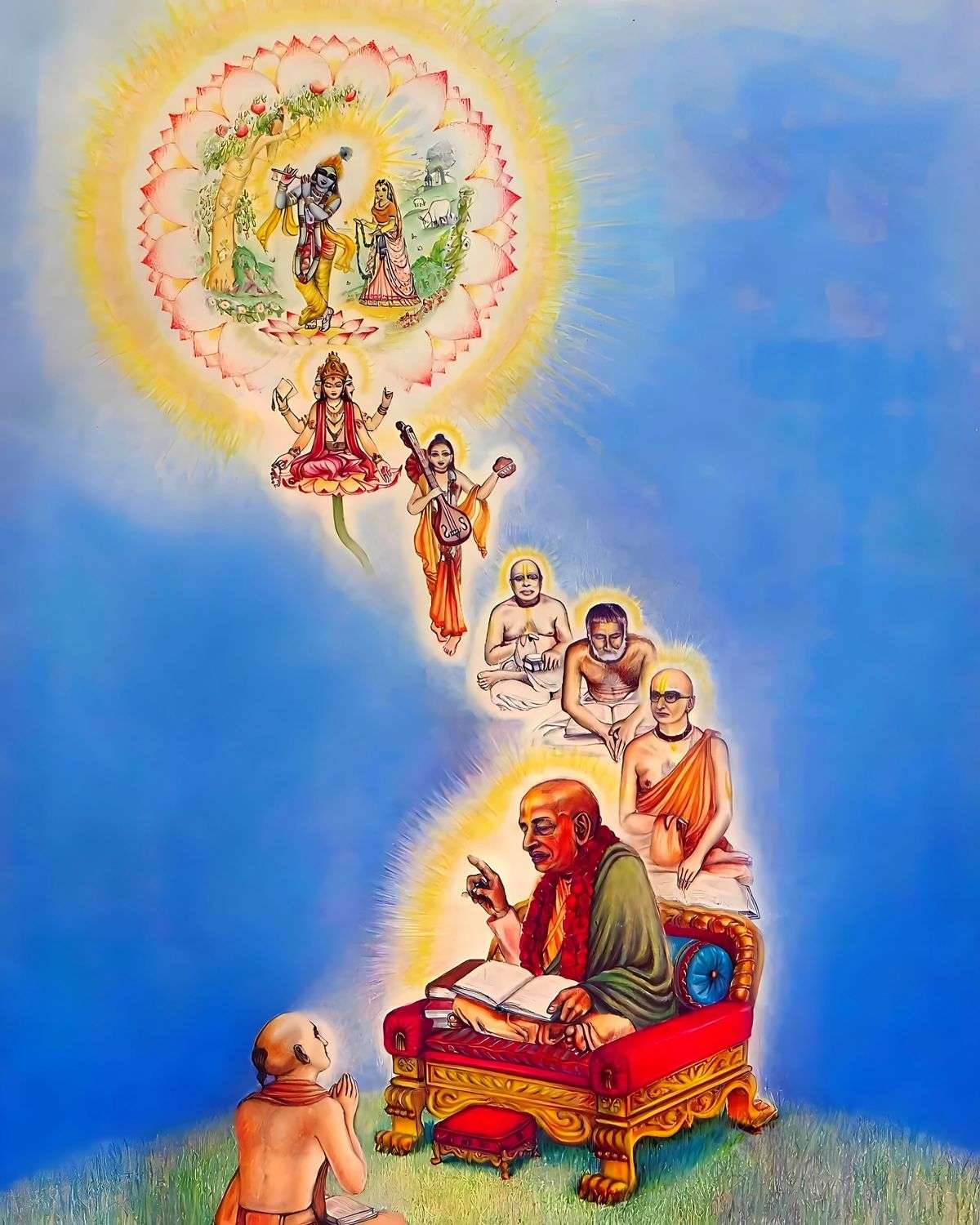
At the beginning of section twenty-nine we find the word atha, commonly used to solemnly indicate the beginning of a sacred discourse. We have said that Suta Gosvami related the Bhagavatam to the sages of Naimisa, repeating what he had heard from Sukadeva Gosvami during the discourse with Pariksit. Jiva Gosvami reports that in verses 12.12.68 and 69 of the Bhagavatam, Suta pays homage to the nitya-siddha, his spiritual Master: “I pay homage to the son of Vyasa (Sri Sukadeva Gosvami), the destroyer of all sins, whose mind is full of inner happiness.”
Having put aside all other thoughts, he led his heart in the direction of the lovely lilas of Krsna, and with compassion manifested this Purana, which deals with Krsna Himself, illuminating every place like a lamp.
In a sense, it could also be said that it is with this verse that the Gosvami of Vrindavana begins his work, it being legitimate to consider the preceding sutras as introductory. The presence of a guru of Sri Sukadeva’s caliber is essential for spiritual advancement. Without such guidance it is virtually impossible to penetrate directly into the wonders of Krsna’s transcendental pastimes in Goloka Vrindavana.
The Mundaka Upanisad (1.2.12) says:
tad vijnanartham sa gurum evabhigacchet
samit panih srotriyam brahma-nistham
“To learn the science of transcendental devotional service to the Supreme Lord it is necessary to approach, with joined hands, a realized spiritual master, expert in Vedic literature and firm in devotional service to the Lord.”
In this verse the qualities of a disciple and those of a spiritual master are exposed. The former should be eager to meet a genuine guru and study with him with humility and desire to learn (samit panih means “hands folded”); the second should be realized and fixed in spiritual science (Brahma-nistham) and should be experienced in Vedic knowledge (srotriyam).
The Bhagavad-gita (4.34) says:
tad viddhi pranipatena pariprasnena sevaya
upadeksyanti te jnanam jnaninas tattva-darsinah
“Try to understand the Truth by turning to a spiritual master, ask him questions with a submissive spirit, and render him service. The realized soul can impart knowledge to him because he has seen the Truth.”
The humble spirit is the most suitable state of mind for learning. A defiant attitude will only result in a waste of energy and time. Visvanatha Cakravarti Thakura said:
yasya prasadad bhagavat-prasado
yasyaprasadan na gatih kuto’pi
“Without the mercy of a bona fide spiritual master, no progress can be made.”
It is no coincidence that Sri Jiva relates, among many, precisely these verses (Srimad-Bhagavatam 12.12.68 and 69), which also summarize the qualities that a true spiritual master must possess.
- a) First, he points out that Sukadeva belongs to a parampara: he was the son (and disciple) of Vyasadeva. The guru must have received the knowledge of a tradition that has remained intact (evam parampara praptam …).
- b) He must possess the ability (which comes from divine grace) to remove all sins from the life of the disciples and this is not possible if he himself is a slave to them. Therefore, he must be transcendental to the modalities and attractions of matter.
- c) The mind of such a person is permeated with sensations of lively happiness, born of inner separation from matter and the realization of being a spirit soul of saccidananda nature.
(d) His heart should be fixed on the lilas of Krsna and he should not consider any other place worthy.
(e) He must manifest the Bhagavatam, that is, feel the overwhelming need to go and make Krsna consciousness known everywhere and enlighten the hearts of materialists overwhelmed by the ephemeral and illusory attractions of Maya.
As Rupa Gosvami, Sri Jiva’s guru, says, such a person “is qualified to make disciples all over the world.” The description of a pure devotee, a bona fide spiritual master fits perfectly with the image and example of a great Vaishnava Acarya like Sri Jiva and our Master Bhaktivedanta Swami Prabhupada.
This is a section of the book “Tattva Sandarbha”, in English.
To buy the complete book, click here

Leave a Reply