

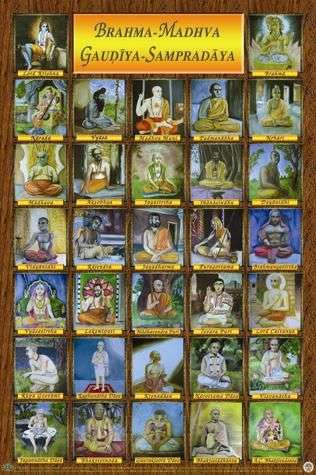
 In section twenty-nine, the author addresses some issues that we have previously discussed briefly. One of them is the declaration confirming his membership in the Brahma-Madhva-Sampradaya. Jiva Gosvami Maharaja is a Vaishnava Gaudiya and some of the descendants of Madhva (the Tattvavadis) still today do not intend to accept the Gaudiyas as an authentic branch of tradition. On the other hand, the debate has always been open even among the Gaudiyas themselves; a lively debate between those who consider themselves part of the Sampradaya of Madhva and those who argue that Mahaprabhu has started a new one, independent of any other.
Baladeva Vidyabhusana proved, on behalf of all the authentic Gaudiyas, that Lord Caitanya regarded himself as a member of Madhva Sampradaya. Srila Prabhupada corroborates this. In the Caitanya Caritamrta (Adilila 1.19) it says:
“Lord Caitanya accepted the chain of succession (which came from) Madhva Acarya, but the Vaishnavas in His line do not accept the Tattvavadis. To distinguish themselves from the Tattvavada branch, the Vaishnavas of Bengal prefer to call themselves Gaudiya Vaishnava. One of the names of Sri Madhva is Sri Gauda Purnananda, hence the name Madhva-Gaudiya-Sampradaya is suitable for the disciplic succession of Vaishnava Gaudiya. Our spiritual master, Om Visnupada Srimad Bhaktisiddhanta Sarasvati Gosvami Maharaja, accepted initiation into the Madhva Gaudiya Sampradaya.”
Therefore, the controversy seems to change: it is not the Tattvavadi who do not accept the Gaudiyas as legitimate belonging to the noble tradition, but exactly the opposite. The descendants of Caitanya do not reject Madhva and his line, but his heretical offshoot.
Some may ask: Could Gauranga Mahaprabhu have initiated a new Sampradaya, He being none other than the Supreme Personality of Godhead?
Technically, it could have been done very well. Sampradayas are always initiated by Sri Krishna or one of His emanations; no ordinary man can initiate a tradition of transcendental knowledge. Only the man of God, the one who is invested with spiritual power, can do this. The four authentic Sampradayas of Kali-yuga all have a divine origin. Brahma received knowledge from Visnu as well as from Laksmi, who then entrusted it to Ramanuja. Visnusvami was taught by Shiva, and the Kumaras were students of Hamsa, one of the avataras of Visnu. The latter (the Kumaras) in turn taught in Nimbarka. Sri Caitanya, therefore, could very well have initiated a new Sampradaya, since he himself is Krishna, but he did not do so because he was in the feeling of the devotee (bhakta-rupa) and a devotee is not in the mentality of the master but in that of service and subordination (trinad api sunicena taror api sahisnuna). Therefore, there is no doubt that Lord Caitanya wanted to be part of the Madhva Sampradaya. The other considerations, that is, those for which the Gaudiyas pretended to be part of it only by opportunism are opinions that are born of minds without spiritual vision.
However, it is true that Lord Caitanya has introduced new theological elements of Madhva’s Sampradaya. After some centuries of the latter’s disappearance, many of his descendants had deviated from the path of bhakti and embarked on that of logic, ritual and cold discipline. Reform was therefore necessary.
But beyond the historical deviations, it is also true that Madhva’s teaching did not have the same content as that of Lord Caitanya: his mission did not foresee it. This is not something new in the history of Vaishnavism. Occasionally, an acarya changes or perfects the pattern of his predecessors, according to the sacred principle of kala, desa, patra (time, place and circumstance). By doing this he does not create conflict but corrects some general lines. Just look at how Jiva Gosvami addresses Sridhara Swami: he calls him venerable Vaishnava, although he promoted various monistic views. Regarding the relationship between the Gaudiya Vaishnavas and Sridhar, readers of the Caitanya Caritamrita will not fail to recall how Lord Caitanya rebuked the famous Vallabhacarya:
“To enter into the plans and logic of the Lord there is a need for purity: only then does one become able to participate in His lilas and to understand the relationships that exist among the great Vaishnavas. Without this cleansing of the heart and mind, one enters the realm of petty mental speculation and ends up committing a disastrous blunder.”
This is a section of the book “Tattva Sandarbha”, in English.
To buy the complete book, click here

Leave a Reply