

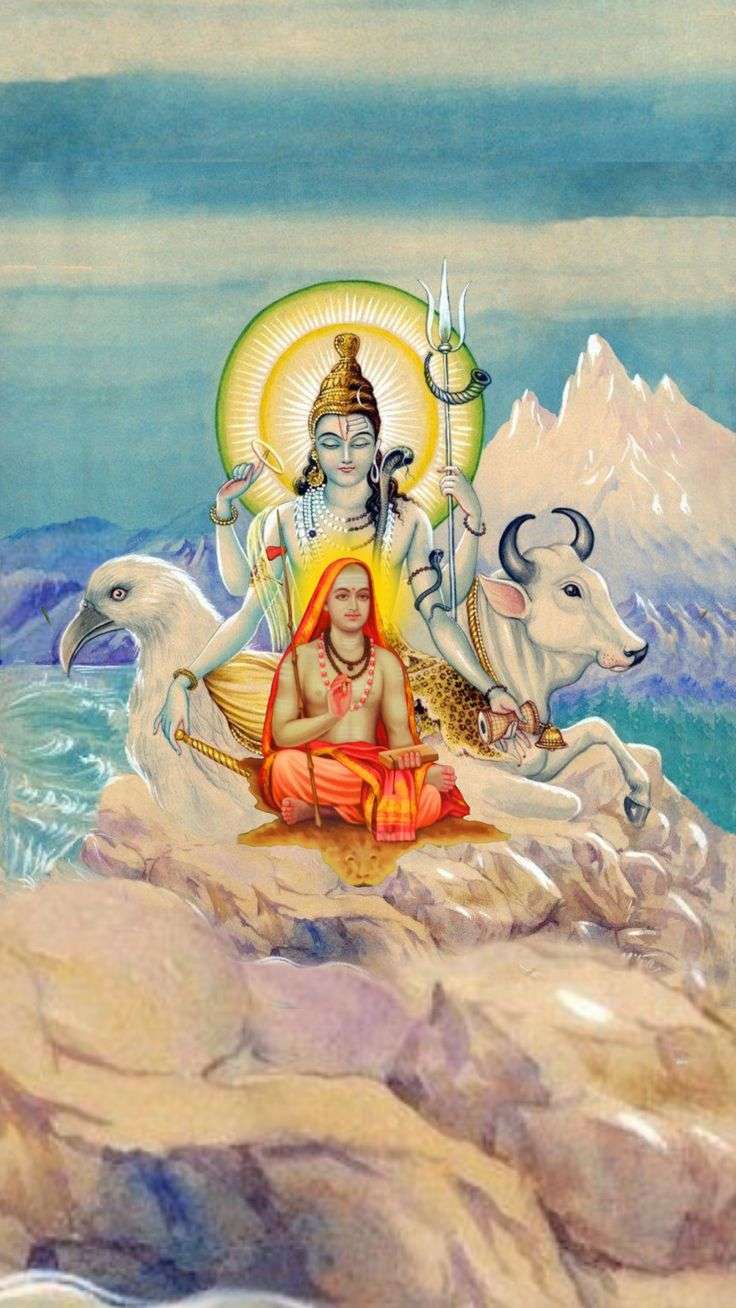
 During his accusation aimed at demonstrating the superiority of Bhagavatam, the author of the Sandarbhas also touches on other topics. One refers to the famous Shankara, also called Shankaracarya.
Shankara, commonly recognized as an Avatara of Shiva, understood the ultimate meaning of Bhagavatam, characterized by statements concerning the pleasures of bhakti, pleasures that surpass even the happiness of liberation. He understood that this truth was superior to what he had taught and feared disturbing the views set forth in this divinely composed explanation of Vedanta. As will be explained later, He propagated Advaita doctrine as a result of Bhagavan’s command, pursuing the goal of keeping His true nature hidden. To this end, Shankara touched on the Bhagavata only indirectly, describing in works such as the Govindastaka and others certain events found only in the Bhagavata, such as Mother Yasoda’s amazement at the vision of the universal form manifested by Krishna.
Sri Baladeva explains this paragraph in the following words:
Shankara reflected, “I am responsible for the dissolution of the universe and I am a devotee of Hari. Therefore, I have honored His command, commenting on the Upanisads and other scriptures in that way to distort their true meaning. But if I also disturbed His beloved Bhagavatam, the Lord would be angry with me. Therefore, it is better not to. However, in this way I will be deprived of wisdom and joy (since I could not recite the Bhagavatam). Somehow I have to get in touch with Srimad-Bhagavatam.”
Thinking in this way, he included in his poetry certain events recorded only in the Bhagavata Purana, such as the vision of the universal form and others. This shows that Shankara respected the universally honored Supreme Scriptures.
This is a section of the book “Tattva Sandarbha”, in English.
To buy the complete book, click here

Leave a Reply