

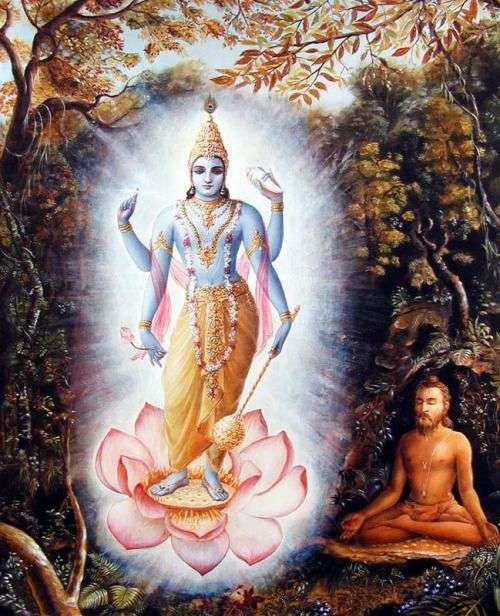
If we understand that the inner nature of the jiva is formed by consciousness and eternity, we can also understand the Being referred to by the term tat, which is made of the same essence. And it could not be otherwise, for the soul is “created in His image and likeness”.
Referring to this principle, sage Pippalayana says to Maharaja Nimi:
“There are two types of souls, the Supreme Soul and the subordinate soul. Both are called Atma, but the Supreme is omnipotent because it is great, while the other is insignificant because it is small. Inevitably, there is an influence of the higher power on the lower one (the soul), but the fact is that the jiva is never destroyed, nor is it born, never grows or grows old and acts as a witness during the life events just mentioned (growth and old age). The atma, always eternal, unchanging, and composed of pure consciousness, is conceived by observers as manifold due to the perception of the senses.”
Therefore, the theory called viparinama, according to which the soul changes, is contested by the sage Pippalayana. Although he witnesses the many changes that the body undergoes, he remains unchanged. The body changes, but the soul does not.
But the other Atma, the one who has no conditioning, called upalabdhimatram (i.e., composed of pure and supreme consciousness), is everywhere, in every body and in every moment of existence. Differences are conceived by us, with our relative and imperfect senses, but consciousness never changes. It is the mind that is transformed, explains Jiva Gosvami, and these changes come and go, but not consciousness. This answers the objection in question.
The difference between the soul and the body is then reaffirmed, a concept that is the basis of any philosophical inquisition that pretends to know the transcendent. Without understanding this, proceeding will be difficult.
The dehinah, what is inside the body, is free from originations, while the deha, the body, has a moment of creation and immediately afterwards undergoes destruction. We also find an additional element of reasoning: the observer, the soul, must necessarily be distinguished from the observed (the body and the events that concern it).
This is a section of the book “Tattva Sandarbha”, in English.
To buy the complete book, click here

Leave a Reply