

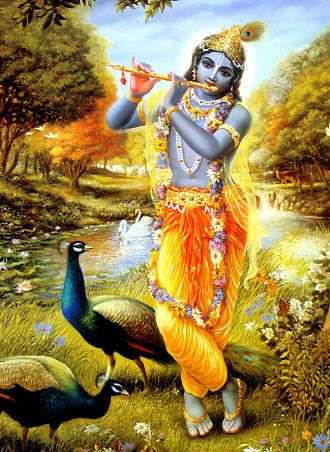
 Some might object: but is Krishna really the Purna-purusa that Vyasa sees and that we should worship?
To this question-objection Jiva Gosvami answers:
“After that, to clarify the nature of the prayojana and to reveal the fact that the Purna-purusa is none other than Krishna, Suta recites verse 1.7.7, which describes another experience of Vyasa and which has the effect of indicating the results of hearing Srimad-Bhagavatam.”
The first line of the verse in question reads:
yasyam vai sruyamanayam
krishna parama-puruse
leaving little room for speculative interpretations: the Parama-purusa is really Sri Krishna. The effects of which Sri Jiva speaks are explained in the verse itself, which we present in full:
“Simply listening to this Vedic literature (the Bhagavatam), the feeling of loving service to Lord Krishna, the Supreme Personality of Godhead, immediately springs up and extinguishes the fire of lamentation, deceit and fear.”
Sri Jiva says here that, contrary to the above, the word bhakti means prema. In fact, here we are talking about the final goal, which is precisely prema. Through bhakti (sadhana-bhakti) prema-bhakti is developed.
In the second part of section forty-seven, we return briefly to the question of who is the Purama-purusa. Suta Gosvami, esteemed orator of the Vedic era, does not seem to hesitate:
“The Supreme Personality of Godhead is Krsna.”
Jiva Gosvami Maharaja points out that there are innumerable testimonies in this regard, both from the scriptures and from the trials conducted. Sri Krishna Bhagavan, who appeared at the end of the last Dvapara-yuga by Devaki and Vasudeva, then adopted by Yasoda and Nanda, who became the king of Dvaraka and who recited the Bhagavad-gita on the battlefield of Kuruksetra, is in fact the Supreme Personality of Godhead; outside of Him there is nothing.
Sri Jiva opens a brief parenthesis to discuss the meaning of the various names of Krishna. He says that the word Krishna means mainly “dark as the tamala tree,” but also “one who is suckled by Yasoda” and “the Supreme Brahman”. This information comes from the Namakaumudi of Laksmidhara; the whole verse is mentioned in the Krishna-sandarbha.
tamala-syamala-tvisi
sri-yasoda-stanan-dhaye
krishna-namno rudhir iti
sarva-sastra-vinirnayah
“The only meaning of the Holy Name of Krsna is that He is dark like a tamala tree and is the son of mother Yasoda. This is the conclusion of all revealed scriptures.”
The verse also appears in Caitanya Caritamrita, on the occasion of the memorable dialogue between Lord Caitanya and Vallabhacarya.
This is a section of the book “Tattva Sandarbha”, in English.
To buy the complete book, click here

Leave a Reply