Index of Tattva Sandarbha
Index Index 5 Introduction 9 Biography of Srila Jiva Gosvami Prabhupada 13 General notes 13 The six Gosvamis of Vrindavana 14 Early life 16 Arrival in Vrindavana 19 Criticism of Jiva Gosvami 21 His fame spreads … Read More
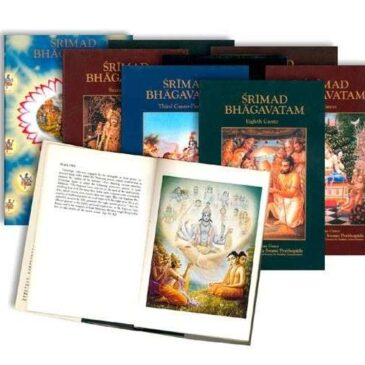
Twentieth Theme: The Characteristics of the Sacred Puranas The Bhagavatam (12.7.9 and 10) says that a Purana should deal with the following ten categories of subjects: 1) sarga 2) visarga 3) vrtti 4) raksa … Read More
Nineteenth Theme: The Themes of Srimad-Bhagavatam From section fifty-six to sixty-three, Srila Jiva Gosvami describes the tattvas contained in the Bhagavatam. The tattva, or truth, which forms the basic argument of the Bhagavatam is … Read More
Baladeva Vidyabhusana then says that the body undergoes six kinds of transformations. In the continuation of the verse of the Bhagavatam (11.3.39), Pippalayana Muni continues his reasoning and says that prana, the vital air that … Read More
If we understand that the inner nature of the jiva is formed by consciousness and eternity, we can also understand the Being referred to by the term tat, which is made of the same essence. And … Read More
Gosvami Maharaja concludes the section with these words: “Since the word tattva indicates the highest goal of life, this consciousness must be composed of supreme and eternal happiness.” But some might object: ‘Consciousness, that … Read More
Eighteenth Theme: Further Comparison Between What Is Supreme and What Is Not Let’s start with section fifty-one. Assuming the role of the disciple, Sri Jiva raises the question of how it is possible to know … Read More
Seventeenth Theme: The Disciplines of Sadhana-bhakti In the fiftieth section, Sri Jiva says: Now, wishing to determine the real meaning, i.e. the correct conclusions (siddhanta) (according to the version of Vyasa and Sukadeva), in these six … Read More
One day, Vallabha Bhatta went to Lord Caitanya and asked him to listen to the commentary on Srimad-Bhagavatam that he had written. Proud of his work, he went so far as to claim that it was … Read More
Some might object: but is Krishna really the Purna-purusa that Vyasa sees and that we should worship? To this question-objection Jiva Gosvami answers: “After that, to clarify the nature of the prayojana and to reveal the … Read More
This revelation offers us the opportunity to talk about the difference between sadhana-bhakti and raga-bhakti (ragatmika-bhakti). The first is the initial stage of devotion, in which the devotee’s heart is still contaminated with material desires and … Read More
Sixteenth Theme: Bhakti-yoga, devotional service to the Supreme Personality of Godhead The description of Sri Vyasadeva’s vision continues. In the verse of Srimad-Bhagavatam (1.7.6), he realizes what are the means necessary for the ultimate realization … Read More
If the Abheda-vada (the doctrine of non-differentiation) corresponded to reality, the realized sages would have testified to it. Instead, in the teachings and experiences of Vyasa, Sukadeva and Suta Gosvami we find the opposite description. In … Read More
Even dream theory does not find Sri Jiva in agreement. According to this, portions of unlimited Brahman dream of being something they are not. Awakening to transcendental knowledge makes them realize that they are nothing but … Read More
To Pratibimba-vada Jiva Gosvami responds in this way: “That which has no attributes, which pervades everything and has no parts, cannot be reflected anywhere; what lacks attributes cannot have connections with superfluous appendages; if Brahman … Read More