

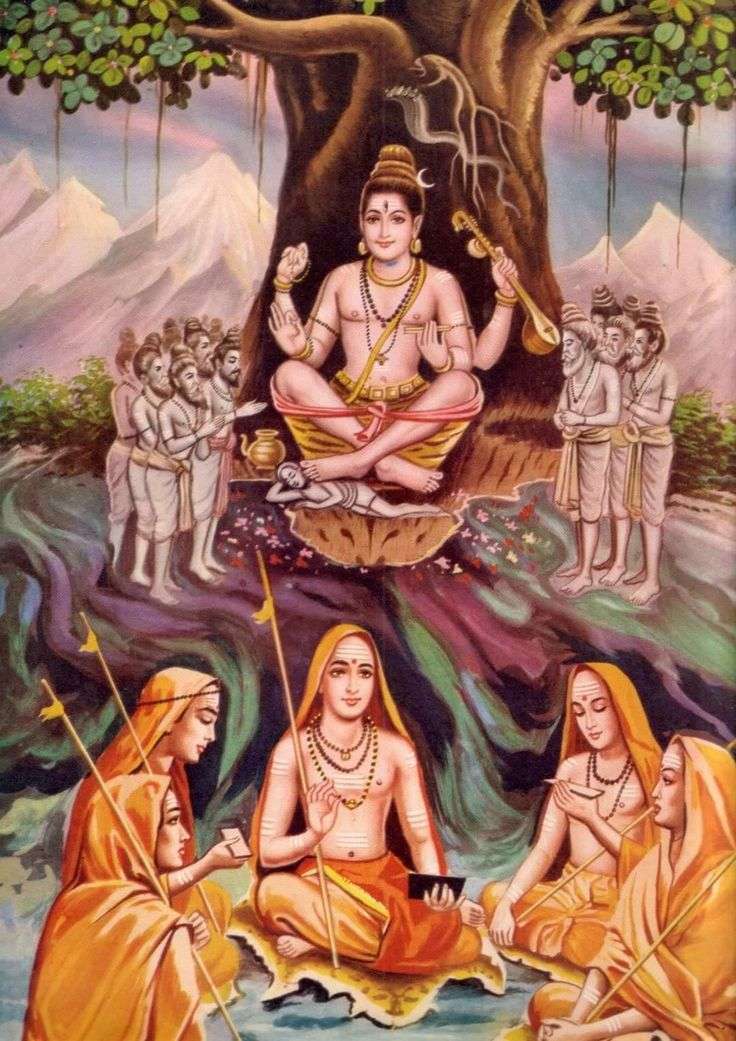
 It is well known that Shankara is an incarnation of Shiva and also that his descent as Acarya from Advaita philosophy is a concerted plan with the Supreme Lord. In the Padma Purana (Uttara Khanda 62.31) Sri Krishna says:
“You can announce yourself, but not Me. Drag people away from Me by composing your own Scriptures. Hide Me from their sight, for in this way creation will continue uninterruptedly.”
In other words, Krishna says that thanks to the falsehoods contained in Advaita-vada, non-devotees will continue to be reborn in this world. And still in the same Purana (Uttara Khanda 25.7), Shiva says to Parvati:
“This false doctrine of Mayavada is occult Buddhism. O Devi, during Kali-yuga, I myself propagated this doctrine culture, taking the form of a brahmana.”
From these words (verbs are conjugated in the past tense) we observe that Shankara’s incarnation is also cyclical.
Section twenty-four deals with Madhvacarya. The particle kila, used by Jiva Gosvami in the first verse of the section under consideration, indicates that what follows is part of ancient wisdom.
It was after reading the Srimad-Bhagavatam and realizing that Shankara respected this divine text that the revered Madhva accepted the Vaishnava’s conclusions, even though he was a disciple of Shankara.
Some claim that Madhva had been a direct disciple of Shankara, but this is not confirmed. He had been initiated by a guru of the Shankaracarya Sampradaya whom he would later reject, receiving initiation and instruction from Vyasadeva himself. Prabhupada, speaking of Madhva, adds nothing different. Something so important would not have been omitted. In addition, there are centuries of difference between the two acaryas. Therefore, a disciple must be understood as a spiritual descendant.
Fearing that other Vaishnavas might fall under the influence of commentaries written by Shankara’s descendants, he wrote a bhasya indicating the right path.
For the reasons just expressed, Shankara did not write commentaries on the Bhagavatam, but some of his direct and non-direct disciples wrote about it, such as Punjaranya and others. Fearing that people would fall victim to the false teachings of the Advaitavadi and lose their path of devotion in the tunnels of intoxication of the intellect (a typical state of the Abhaktas), he wrote a commentary on Srimad-Bhagavatam entitled Bhagavata-tatparya. In these pages Madhva defeats the theories of the Mayavadis and establishes the supremacy of the Personality of Godhead, which is beyond attributeless Brahman (nirguna-brahman).
This is a section of the book “Tattva Sandarbha”, in English.
To buy the complete book, click here

Leave a Reply