

 Twelfth Theme: Liberated Souls Also Study Bhagavatam
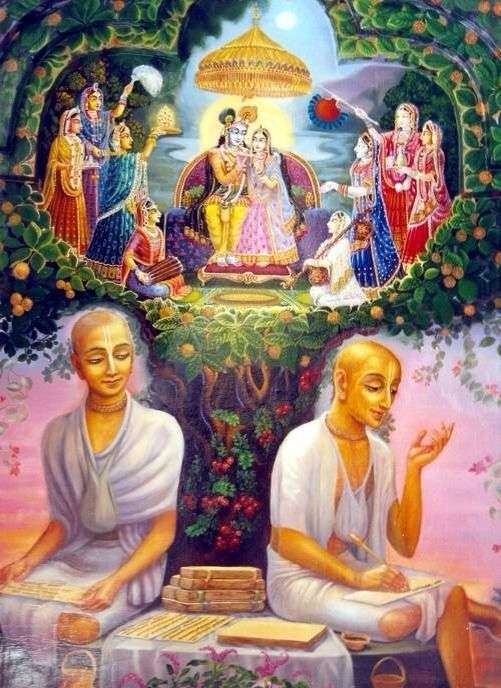
Sri Jiva begins section thirty by introducing the principle of jiva, pointing out that even liberated souls prefer to listen to Srimad-Bhagavatam. We will give a summary of the first verses of the first Canto, seventh chapter of the aforementioned Scripture:
“After the departure of Sri Narada Muni, Vyasadeva went to the western bank of the Sarasvati River to Samyaprasa and, having been purified by acamanna, sat down to meditate. By this devotional absorption (bhakti-yogena manasi), he saw the Supreme Personality of Godhead in the company of His external energy, always under His control. Vyasa had a clear view of how the living entities, although transcendental to the three modes of material nature, believe that they are the product of matter and thus become victims of the reactions of material miseries. Contact with Maya is totally superfluous to the jiva and the resulting sufferings can be directly mitigated by the yoga process of devotional service (bhakti-yoga adhoksaje).
But the common people were ignorant of these basic realities, so the sage Vyasadeva took it upon himself to write the Vedic literature, which is related to the Supreme Truth (satvata-samhitam). Just by hearing this message, the feeling of devotional service to Lord Krsna, the Supreme Personality of Godhead (krsne parama-puruse), immediately releases and definitively extinguishes the fire of lamentation, deception and fear (soka-moha-bhayapaha).
The sage Vyasadeva, after compiling the Bhagavatam and revising it, taught it to his own son, Sri Sukadeva Gosvami, who was already realized in his own spiritual being.
At this time, Saunaka asked:
“Sukadeva Gosvami was already on the path of self-realization. So why did he undergo the study of such vast literature?”
In other words, since Sukadeva was a liberated soul from birth, what need did he have to study the Bhagavatam?
In response, Suta Gosvami recited the famous atmarama verse:
atmaramas ca munayo nirgrantha apy urukrame
kurvanty ahaitukim bhaktim ittham-bhuta-guno harih
“All the different types of atmarama, especially those who are established on the path of self-realization, wish to render pure devotional service to the Personality of Godhead, although they are free from any kind of material bondage. This means that the Lord possesses transcendental qualities and can therefore attract anyone, including liberated souls.”
Those who have been liberated in the dimension of impersonal brahman do not experience any attraction, this feeling being one of the characteristics of the person. Sukadeva was released following the monistic concept, according to which he should not have been attracted to anything. However, when he heard the description of Lord Krsna’s activities, he immediately felt an overwhelming attraction to Him and to hearing His qualities and deeds. It is therefore understandable that Saunaka wonders how this was possible. Suta Gosvami replied that liberated souls are not attracted to things of a material nature, but the qualities of Krsna are transcendental in nature, therefore they can be the object of anyone’s desire.
This verse, originally spoken by Suta Gosvami, is one of the workhorses of all Vaishnavas. Sri Caitanya Mahaprabhu explained it sixty-one different ways to Sanatana Gosvami and Sarvabhauma Bhattacarya, to whom he gave eighteen different versions. An expert in Sanskrit grammar and Vedic philosophy, using this verse, will be able to prove irrefutably how inconsistent are the Advaita theories, according to which impersonal liberation is supreme. If that were the case, a liberated soul like Sri Sukadeva would not have been attracted to Bhagavatam.
The highest perfection is bhakti-yoga, that is, meeting with Krsna through pure and pristine devotional service.
This was seen by Vyasadeva during his meditation.
Sri Jiva Gosvami begins an analysis of six verses of the Bhagavatam, starting from 1.7.4, which says:
bhakti-yogena manasi
samyak pranihite ‘male
apasyat purusam purnam
mayam ca tad-apasrayam
“Thus, he (Srila Vyasadeva) controlled his mind, fixing it firmly through devotional service (bhakti-yoga), without any trace of materialism; and thus He saw the Absolute Personality of Godhead together with His energy, which was under His control.”
Bhakti-yoga means prema, pure love for God. This prema is undoubtedly superior to mukti (liberation), so it is correct to say that it is the ultimate goal of life. In this regard, Sri Sukadeva told Maharaja Pariksit:
“Those who strive to serve Him obtain deliverance very easily, but the opportunity to render direct service is not granted to them very easily.”
This means that Kṛṣṇa, the Supreme Personality of Godhead, is conquered only by the sincere and intense love of His bhaktas. Others, those who serve Him for some material reason, will probably gain liberation, but not personal service to Krsna. This is also confirmed by the Vaishnava saint Bilvamangala Thakura in his Krishna-karnamrita (#107).
“This devotional service,” Sri Jiva continues, referring to the same verse of Srimad-Bhagavatam, “should be rendered to the Supreme Person (purna-purusa).” This confirms that He is the Supreme Lord. The Padma Purana says:
“The words Bhagavat and Purusa are free from any upadhi, or limiting additions, and refer to Vasudeva, the Self of all.”
Sridhara Swami confirms that those who desire liberation should worship and serve the Supreme Personality of Godhead, Krsna. He mentions Srimad-Bhagavatam (2.3.9):
“One who does not desire worldly pleasures should worship the Supreme Personality of Godhead.”
And, Sridhara Swami continues, even if you have material desires to fulfill, you must worship Krishna.”
This is a section of the book “Tattva Sandarbha”, in English.
To buy the complete book, click here

Leave a Reply